Puzzles for Homeschool: Free Printable Word Searches & Crosswords
Puzzles for homeschool are printable worksheets, like word searches, crosswords, and word scrambles, built from the lessons your kids are learning at home. They reinforce spelling, vocabulary, and subject terms in a hands-on way that fits naturally into a homeschool day. The fastest way to make them is a free puzzle maker that turns any word list into a clean, printable puzzle in a couple of clicks.
Want to make one right now? Open the free puzzle maker, paste in this week's spelling or unit words (there's a ready-made list below), and print a copy for each kid at the table. No account, no fee, no software to install.
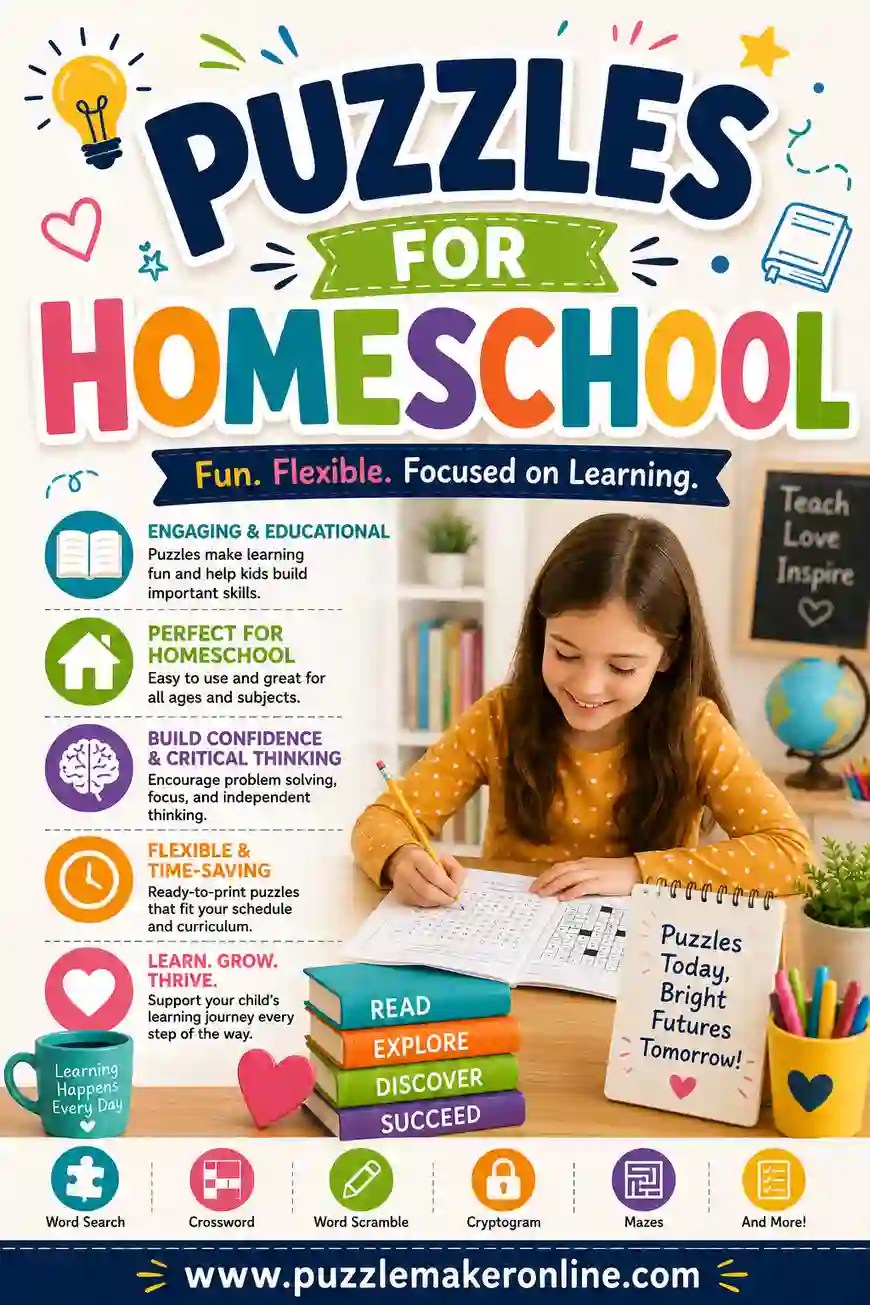
Why Puzzles Fit Homeschool So Well
Homeschooling rewards flexibility, and puzzles bend to whatever your day needs. They work as a warm-up, a review, a quiet activity while you teach a sibling, or a light wrap-up after a heavy lesson. You're not locked into a rigid worksheet schedule the way a classroom might be.
They also let you teach to your own curriculum. Store-bought workbooks come with someone else's words. When you build the puzzle yourself, it's filled with the exact terms from the book you're reading, the science unit you're on, or the spelling list you chose. That alignment is the whole advantage of homeschooling, and a puzzle generator makes it effortless.
Homeschool parents reach for puzzles to:
- Review the week's spelling or vocabulary before a Friday check-in.
- Keep a younger sibling busy while you work one-on-one with an older one.
- Add a hands-on break between sit-down lessons without losing the learning.
- Reinforce a unit in history, science, or geography with the actual terms.
- Make screen-free time that's still productive and calm.
Three Puzzle Types for Your Homeschool Day
Most homeschool needs come down to three formats, each drilling a different skill. Knowing which to grab makes your day smoother.
Word search
Your child hunts for hidden words in a grid. It's calm, low-pressure, and perfect for younger kids or a quiet afternoon. Word searches reinforce spelling and letter recognition without feeling like a test, which makes them a gentle entry point for a reluctant learner.
Crossword
Clues lead to interlocking answers. Crosswords make kids recall the actual word from its meaning, so they're ideal for vocabulary, science terms, or history names. They suit older kids who are ready to connect definitions to words.
Word scramble
Jumbled letters your child rearranges into the right word. Scrambles are fast and great for spelling practice, a single page of this week's words that doubles as a quick warm-up or homework.
A simple rule: word searches to relax, crosswords to think, scrambles to spell.
A Ready-to-Use Homeschool Word List
Here's a flexible set of 30 cross-subject words you can paste straight into the puzzle maker. Pick a column to match your lesson, or mix across all three. Better yet, swap in your own unit words, the tool handles any list.
| Reading & Spelling | Science & Nature | History & Geography |
|---|---|---|
| Vocabulary | Planet | History |
| Spelling | Volcano | Continent |
| Sentence | Insect | Mountain |
| Syllable | Habitat | River |
| Adjective | Gravity | Country |
| Paragraph | Magnet | Pioneer |
| Rhyme | Weather | Castle |
| Chapter | Energy | Compass |
| Author | Mineral | Explorer |
| Vowel | Recycle | Ocean |
This list spans several subjects so you can build a quick review across the week's lessons, then make subject-specific puzzles whenever you have a unit to reinforce.
How to Make a Homeschool Puzzle in 4 Steps
No design skills or special software needed. Here's the whole process.
- Pick your puzzle type. Word search, crossword, or scramble, based on the skill you're working on.
- Paste your word list. This week's spelling words or your current unit vocabulary. For crosswords, add a short clue for each.
- Set the difficulty. Match grid size and complexity to your child's age and level.
- Print it. A copy per kid, plus the answer key so you can check it at a glance.
The whole thing takes a few minutes, and one word list can become a word search today and a crossword next week.
Match the Puzzle to Your Child's Age
The same word list can serve a kindergartner or a middle schooler with a few setting tweaks. Use this as a quick guide.
| Age / grade | Best puzzle | Difficulty notes |
|---|---|---|
| Ages 4–6 | Word search | Small grid, words across and down, large letters |
| Ages 7–9 | Word search or scramble | Medium grid, short words, simple clues |
| Ages 10–12 | Crossword or scramble | Diagonal words, fuller clues, more words |
| Ages 13+ | Crossword | Tight grid, longer words, detailed clues |
| Multiple ages | Word search | Hand each child a different size from the same list |
Teaching several kids at once is the homeschool reality, and puzzles handle it gracefully. Build one easy version for the little one and a harder version for the older sibling from the very same word list. The generator regenerates in seconds, so differentiating costs you almost nothing.
Tips for Puzzles That Actually Teach at Home
A puzzle is only as good as the words you put in it. A few habits make yours land better.
- Tie words to your current lessons. A puzzle full of this week's vocabulary doubles as review. Random words are just filler.
- Keep word counts reasonable. Ten to fifteen words per page is plenty. Too many and the grid gets cramped and frustrating.
- Print the answer key. It saves you from solving the puzzle yourself to check it. The generator makes one automatically.
- Use concrete words for little ones. Stick to words they can spell and picture; save the tricky terms for older kids.
- Mix it up across the week. A scramble Monday, a crossword Friday, so kids feel the variety and the progress.
Make them reusable
Print on cardstock or slip pages into clear sleeves, and kids solve with dry-erase markers. Wipe them clean and the same set serves the next child or the next year. This is a real money-saver when you're homeschooling multiple kids through the same curriculum.
Build Puzzles Into Your Homeschool Routine
Puzzles do more than fill time. Woven into your routine, they become a reliable teaching tool.
- Morning warm-up. Start the day with a quick scramble to ease kids into focus mode.
- Independent work. Hand a word search to one child while you teach another one-on-one. It buys you uninterrupted time.
- Unit wrap-up. Finish a history or science unit with a crossword of the key terms to lock them in.
- Quiet afternoons. A pile of themed puzzles makes a calm, screen-free activity for a long afternoon.
- Co-op days. Puzzles work great when several homeschool families meet up; everyone can solve at their own pace.
That independent-work trick is worth its weight in gold. The same idea, a self-running activity that frees you up, drives our guide to early finisher puzzles. And if you also teach English vocabulary at home, our puzzles for ESL guide layers in word banks and picture support.
Borrowing Classroom Tricks for Home
Homeschool parents don't have to reinvent everything. A lot of what works in a classroom scales down beautifully to a kitchen table.
Building puzzles from your unit vocabulary, printing an answer key, and making two difficulty levels are all standard classroom moves, and they work just as well for one or two kids. Our broader puzzles for teachers guide covers these tactics in depth, and most of them translate directly to home learning. Even the idea of a no-prep backup activity, central to our sub plan puzzles guide, helps on the days when you need your kids occupied while you handle something else.
Build a Reusable Puzzle Library at Home
One of the quiet joys of homeschooling several kids, or one kid over several years, is that nothing has to be made twice. A little organization turns every puzzle you build into a permanent resource.
Keep your word lists saved by subject and grade in a simple document or folder. When your younger child reaches the unit your older one finished two years ago, the word list is already there, ready to paste and print. The same plant vocabulary, the same spelling list, the same history terms, all reusable in seconds.
This compounds over time. By your second or third year, you've got a stocked library of word lists covering most of your curriculum, and building a puzzle for any lesson takes barely a minute. That's prep time handed back to you, the kind of efficiency that makes a long homeschool year feel lighter.
Frequently Asked Questions
Are these puzzles for homeschool really free to print?
Yes. You make and print them yourself at no cost. There's no sign-up, no watermark, and no fee, so you can build a full year of worksheets for free.
What puzzle type is best for teaching vocabulary at home?
A crossword. Because your child reads a clue and recalls the actual word, it connects meaning to spelling. Word searches and scrambles are better for spelling practice and quick warm-ups.
Can I make puzzles for kids of different ages at the same time?
Yes. Paste your word list once, then adjust the grid size and difficulty for each child. The puzzle maker regenerates in seconds, so an easy version and a hard version from the same list takes almost no extra time.
Do homeschool puzzles come with an answer key?
They do. The generator creates a matching answer key automatically, so you can check a finished puzzle at a glance instead of solving it yourself.
How many words should a homeschool puzzle have?
Ten to fifteen words is comfortable for one page, and fewer for young children. A short, focused puzzle works better than a crowded one that overwhelms a young learner.
Can I tie puzzles to the curriculum we already use?
Absolutely, that's the main benefit. Just pull the key terms from your current reader, science chapter, or spelling list and paste them in. The puzzle is built from your exact lessons, so it reinforces precisely what you're teaching.
Ready to Make Your First Homeschool Puzzle?
Grab the word list above, open the free puzzle maker, and you'll have a printable word search, crossword, or scramble built from your own lessons in minutes. It's free, there's no sign-up, and you can make a fresh puzzle for every unit and every kid. Your next warm-up, review, or quiet-afternoon activity is one click away.