Puzzles for Dyslexia: Which Puzzles Help, Which Frustrate, and How to Adapt Them
The best puzzles for dyslexia are the ones that play to a person's strengths instead of piling on the exact thing that's hard for them. Puzzles built on shapes, paths, numbers and logic, like mazes, sudoku, nonograms and visual logic puzzles, tend to be the most enjoyable for many dyslexic children and adults. Letter-heavy puzzles such as word searches and crosswords can still work, but they're usually much more pleasant when you adapt them: bigger letters, more space between them, fewer directions, and shorter word lists. One important point up front: puzzles are a hobby and a confidence builder, not a treatment for dyslexia.
This guide explains what dyslexia is (and isn't), why some puzzles frustrate dyslexic solvers, which kinds tend to suit them, and exactly how to adapt a printed puzzle so it's easier to read. It's written for parents, teachers, tutors, and dyslexic adults who simply enjoy puzzles and want them to be less of a fight.
Please note: this article is general information, not medical, psychological or educational advice. Every dyslexic person is different. If you have questions about reading difficulties, an assessment, or support at school or work, talk to a qualified professional such as an educational psychologist, a specialist dyslexia teacher or assessor, or your child's school. Rules on assessments and accommodations vary by country, state and school system.
What dyslexia is, and what it isn't
Before choosing puzzles, it helps to be clear about what dyslexia actually involves, because a few common myths lead people to pick the wrong activities.
The U.S. National Institute of Child Health and Human Development (NICHD) describes dyslexia as the best-known type of reading disorder, mainly involving difficulty reading individual words. People with dyslexia often find it hard to sound out words, make sense of written words, and quickly name objects. NICHD stresses that dyslexia is not a sign of lower intelligence and doesn't mean someone is unwilling to learn.
The Yale Center for Dyslexia & Creativity describes it as an unexpected difficulty in learning to read, unexpected because it happens in people whose intelligence would normally let them read much better. Yale's page says dyslexia affects 20 percent of the population and accounts for 80 to 90 percent of all people with learning disabilities. The British Dyslexia Association uses a more conservative figure on its main dyslexia page, saying about 10 percent of the population is thought to be dyslexic. Estimates differ because researchers and organizations draw the line in different places. Either way, dyslexia is common.
The BDA's working definition calls dyslexia "a set of processing difficulties that affect the acquisition of reading and spelling," and notes it can also affect other skills, like math or learning another language. Importantly for puzzle lovers, the BDA adds that many dyslexic people show strengths in reasoning and in visual and creative fields. Yale makes a similar point, describing many dyslexic people as fast, creative thinkers with strong reasoning abilities.
Common myths
| Myth | What the sources say |
|---|---|
| Dyslexia means low intelligence | No. NICHD says people with dyslexia typically have average or typical intelligence but read well below the level expected for them. |
| Dyslexia is an eyesight problem | No. The American Association for Pediatric Ophthalmology and Strabismus (AAPOS) describes it as a language-based, brain-based learning disability, not a vision problem. |
| Colored glasses or eye exercises cure it | AAPOS states there's no scientific evidence that vision training or colored lenses improve academic performance in children with learning disabilities. |
| It comes from poor teaching or not trying hard enough | No. NICHD says dyslexia doesn't reflect unwillingness to learn, and the BDA's definition points to multiple genetic and environmental influences. |
| Puzzles can fix dyslexia | There's no good evidence for that. Puzzles can be fun, build confidence and give practice, but reading support comes from qualified teaching. |
The AAPOS points come from its patient page on learning disabilities. That page also makes a sensible practical point: children who fail a vision screening should still see an eye doctor, because ordinary, treatable eye problems can make any reading task harder. A child who needs glasses will struggle with a word search whether or not they're dyslexic.
Why some puzzles frustrate dyslexic solvers
Think about what a classic word search asks you to do. You hold a word in memory, then scan a dense block of letters, in up to eight directions, looking for that exact sequence. For a fluent reader, that's a pleasant hunt. For someone who already has to work harder to recognize letters and words, it can turn into a draining exercise in the exact skill that's hardest for them.
Visual crowding
One reason is a phenomenon called crowding: the difficulty of recognizing a letter when other letters are packed closely around it. Everyone experiences crowding to some degree, which is why tiny, tightly spaced text is hard for anyone to read. But research suggests many dyslexic readers are more affected by it.
The clearest evidence comes from a 2012 study published in the Proceedings of the National Academy of Sciences, "Extra-large letter spacing improves reading in dyslexia", by Marco Zorzi and colleagues. They tested 74 dyslexic children aged 8 to 14, in Italian and French. When the researchers added extra space between letters (and proportionally more between words and lines), the children's reading errors dropped by roughly half, and their reading speed improved. The extra spacing didn't help a comparison group of younger children who were reading at the same level without dyslexia. The authors put the effect down to crowding: spreading letters out reduces the interference between neighbors.
A standard word search is close to a worst case for crowding. It's a wall of evenly spaced letters with no word breaks, no meaning to help, and often small type. That doesn't mean dyslexic people can't do word searches. It means the default format puts the difficulty in the wrong place.
Other common sticking points
- Spelling-dependent answers. A crossword answer you know but can't spell confidently is a frustrating dead end, even though you understood the clue perfectly.
- Look-alike letters. Letters that are mirror images or rotations of each other, like b, d, p and q, are easy for many readers to mix up when they're crowded together in lowercase.
- Diagonal and backward words. Reading against the normal left-to-right direction adds load for any solver, and more so for someone for whom reading is already effortful.
- Time pressure. Races and timed puzzles add stress without adding fun, especially for people who process written words more slowly.
- Too much on one page. Long word lists, cluttered borders and small print make it harder to keep your place.
The UK government's accessibility team makes several of the same points in its design guidance for users with dyslexia: avoid large blocks of heavy text, don't underline words or use italics or capitals for emphasis, don't put too much information in one place, and don't rely on accurate spelling.
Which puzzles for dyslexia tend to work best
Every person is different, so treat this as a starting point, not a rulebook. The general idea is simple: reduce the reading load and lean on reasoning, spatial thinking and pattern-spotting, the areas where the BDA and Yale both note many dyslexic people are strong.
| Puzzle type | Reading load | Why it can suit dyslexic solvers | What to watch for |
|---|---|---|---|
| Mazes | None | Pure spatial planning; no letters at all | Very fine lines can be hard to follow; choose bold, clear paths |
| Sudoku | None (numbers only) | Logic and pattern-spotting, with nothing to spell | Some people have co-occurring difficulties with numbers; start with small grids |
| Nonograms and picture logic puzzles | None | Logic that reveals a picture; very visual reward | Clue numbers can be small; print large |
| KenKen and kakuro | None | Logic plus simple arithmetic | Arithmetic load; pick easy sizes first |
| Tangrams, jigsaws, spot-the-difference | None | Visual and spatial reasoning | Busy images can be tiring; take breaks |
| Grid logic puzzles | Moderate (clues to read) | Reasoning is the main challenge | Keep clues short; read them aloud if helpful |
| Word searches | High | Can be calming and build letter familiarity when adapted | Crowding, diagonals, backward words, small type |
| Crosswords | High | Vocabulary and general knowledge, which many dyslexic people have plenty of | Spelling the answer; consider a word bank |
| Word scrambles and anagrams | High | Short and quick | Letter-order tasks can be especially hard; use with care |
| Cryptograms | Very high | Pattern logic | Heavy letter tracking; usually the least friendly choice |
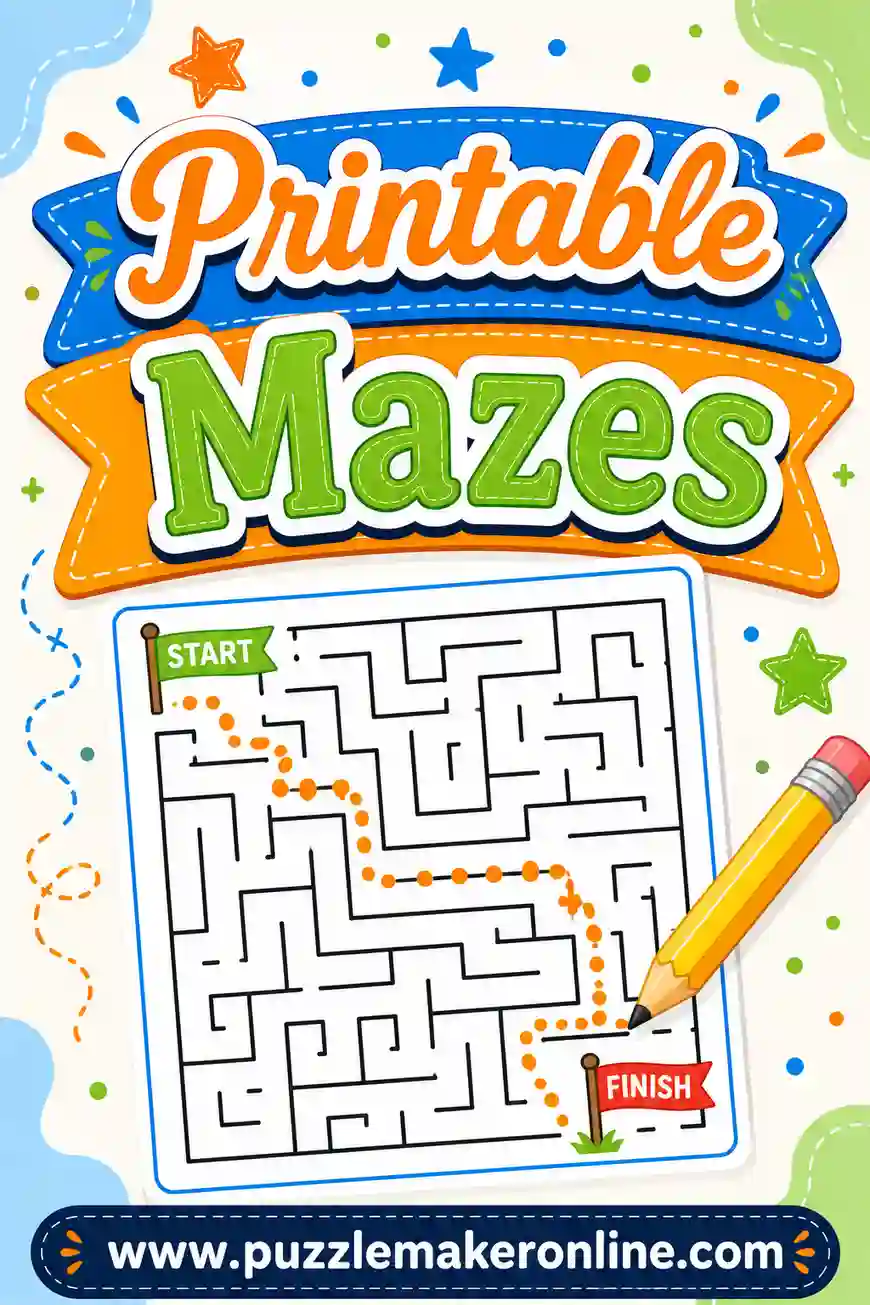
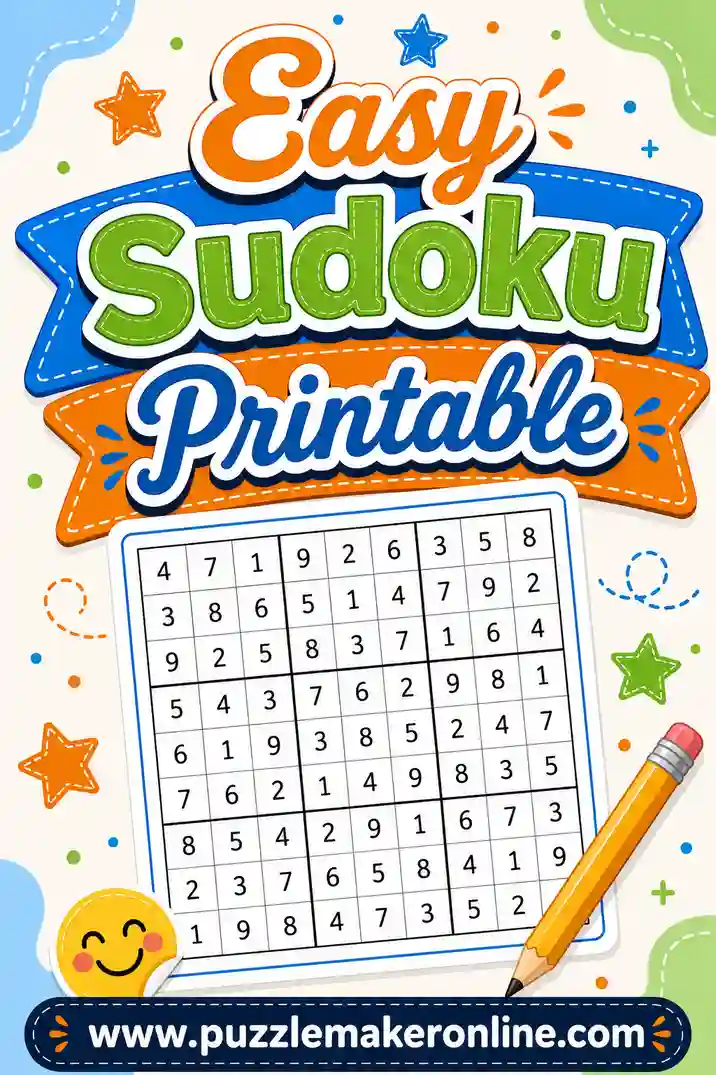
Our collection of printable mazes and our page on easy sudoku are good places to start with the low-reading-load options.
Don't rule out word puzzles
It's tempting to steer dyslexic solvers away from word puzzles altogether. That's often a mistake. Many dyslexic people love words, stories and language; it's the decoding and spelling that's hard, not the ideas. A crossword with a word bank, or a word search with a short list of big, well-spaced words, can be genuinely enjoyable. The goal is to remove unnecessary barriers, not to remove words.
Let the person choose. If someone tells you they like word searches, adapt them. If they find them exhausting, offer a maze instead. Enjoyment is the whole point of a puzzle.
How to adapt a word search for a dyslexic solver
Word searches are the most popular printable puzzle, and they're also the one that most needs adapting. Here's a step-by-step approach.
- Make the grid smaller. A 7x7 or 10x10 grid is far less overwhelming than a 20x20. Fewer letters means less crowding and less scanning.
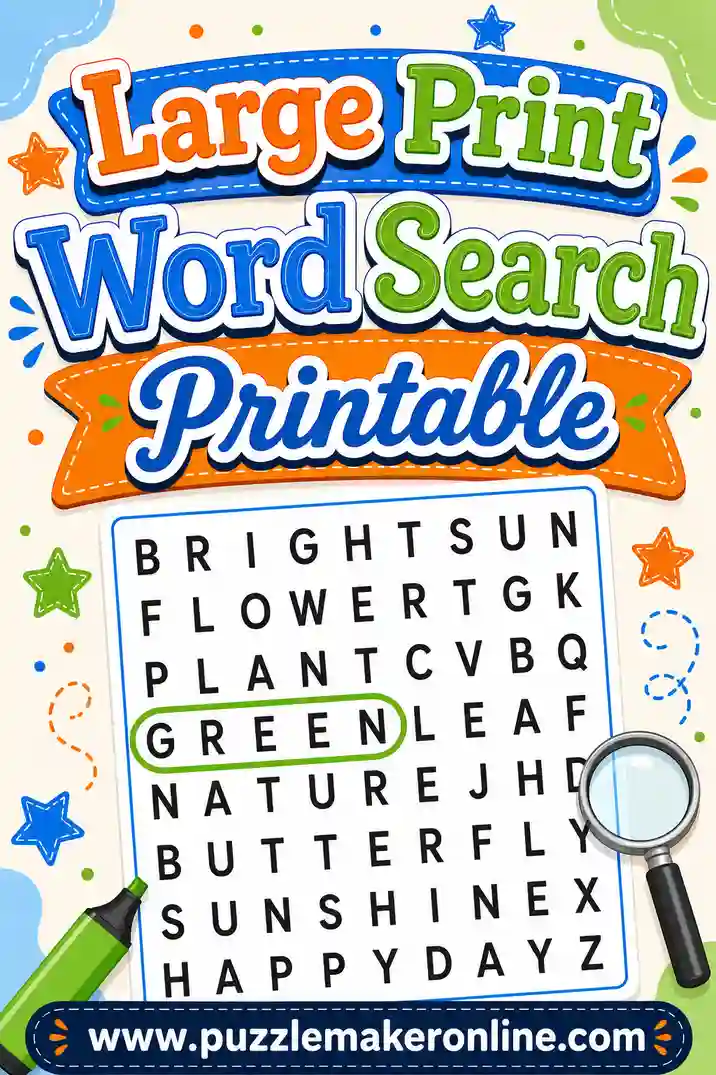
- Use larger type. Print the grid noticeably larger than you would for a fluent reader. Large-print puzzle formats are a good starting point; see our page on large print word searches.
- Add space between letters. The Zorzi study's extra-wide spacing is the strongest evidence for this tip. In a printed grid, that means bigger cells or more white space around each letter.
- Limit the directions. Use only left to right and top to bottom. Skip diagonals and backward words, at least at first.
- Use one case consistently. Uppercase grids avoid the b/d/p/q mirror problem, since B, D, P and Q look quite different from each other in capitals. Just make sure the word list uses the same case as the grid.
- Keep the word list short. Six to ten words is plenty. Print the list large, left-aligned, in a single column.
- Choose meaningful, familiar words. Words the solver already knows and cares about (a hobby, a favorite show, family names) are much easier to spot and more fun to find.
- Allow tools. A ruler or a strip of card under each row helps the eyes track. A finger is fine too.
- Remove the clock. No timers, no races, no "first to finish wins."
An adapted example
Here's a small garden-themed word search built to those rules. It's 7x7, all uppercase, and every word reads either left to right or top to bottom. We checked it with a short computer program to make sure each of the eight words appears exactly once, in any direction, so there are no accidental duplicates to cause confusion.
| Row | 1 | 2 | 3 | 4 | 5 | 6 | 7 |
|---|---|---|---|---|---|---|---|
| 1 | V | M | L | E | A | F | H |
| 2 | X | R | A | I | N | C | V |
| 3 | S | E | E | D | S | V | Z |
| 4 | W | C | S | R | O | R | X |
| 5 | O | N | T | O | I | O | M |
| 6 | R | Z | E | O | L | S | H |
| 7 | M | T | M | T | C | E | C |
Find these words: SEED, ROOT, LEAF, SOIL, RAIN, STEM, ROSE, WORM.
Answer key:
- LEAF: row 1, starting in column 3, reading across
- RAIN: row 2, starting in column 2, reading across
- SEED: row 3, starting in column 1, reading across
- WORM: column 1, starting in row 4, reading down
- STEM: column 3, starting in row 4, reading down
- ROOT: column 4, starting in row 4, reading down
- SOIL: column 5, starting in row 3, reading down
- ROSE: column 6, starting in row 4, reading down
A few design choices worth pointing out. The filler letters avoid B, D, P and Q entirely, so the only D in the grid is the one in SEED. No two words share a letter, so finding one word never "uses up" part of another. And the grid is small enough that the whole thing can be printed in very large type on a single page.
Formatting puzzles so they're easier to read
Whether you're printing a word search, a crossword or a set of logic-puzzle clues, a few layout choices make a real difference. Here's a checklist, with where each recommendation comes from.
| Setting | Dyslexia-friendlier choice | Source or reason |
|---|---|---|
| Letter spacing | Wider than normal | Zorzi et al. (2012); W3C's text-spacing guidance notes dyslexic readers may increase spacing to read faster |
| Line spacing | At least 1.5 times the font size for clue lists and instructions | W3C WCAG text-spacing criterion uses 1.5 as its line-height benchmark |
| Alignment | Left-aligned, consistent layout | GOV.UK accessibility guidance |
| Emphasis | Bold, not underlining, italics or all capitals in running text | GOV.UK accessibility guidance |
| Amount per page | One puzzle per page, short instructions | GOV.UK: don't put too much information in one place |
| Contrast | Let the solver choose; some prefer off-white or tinted paper | GOV.UK: let users change the contrast between background and text |
| Font | A clear, familiar font; no need for special "dyslexia fonts" | Wery and Diliberto (2017) found no reading benefit from OpenDyslexic |
| Support | Pictures next to words where possible | GOV.UK: use images and diagrams to support text |
A note on all capitals: the GOV.UK guidance advises against writing in capitals, and that's good advice for sentences, instructions and clues. Inside a word search grid, though, uppercase is the norm and helps with look-alike letters. The practical compromise is uppercase for the grid and its matching word list, and normal sentence case for instructions and clues.
What the WCAG numbers mean
The World Wide Web Consortium's accessibility guidelines include a success criterion on text spacing. It sets these benchmarks, each relative to the font size: line height of 1.5 times the font size, paragraph spacing of 2 times, letter spacing of 0.12 times, and word spacing of 0.16 times. The criterion is about web pages being able to handle those settings, not a printing rule, but it's a handy guide for paper too. For 14-point text, for example, 1.5 times gives a line height of 21 points (14 x 1.5 = 21). The W3C's explanation adds that people with dyslexia may increase space between lines, words and letters to read faster.
What about special dyslexia fonts?
You may have seen fonts marketed specifically for dyslexic readers, with heavy, weighted letter bottoms. The evidence for them is weak. In a 2017 study in the Annals of Dyslexia, Jessica Wery and Jennifer Diliberto compared OpenDyslexic with Arial and Times New Roman for a small group of elementary students with dyslexia. Neither the group nor any individual student read faster or more accurately in OpenDyslexic, and none of the students said they preferred it. The study was small, and the authors called for more research, but the takeaway is reasonable: a clear, familiar font with good size and spacing is a safer bet than a specialty font. If a particular person likes a certain font, though, there's no harm in using it.
What about colored overlays?
Some people report that tinted paper or colored overlays make text more comfortable. The BDA's page on things to consider mentions visual stress, such as sensitivity to light or text that seems to blur or move, and notes that a school vision test isn't enough to identify it. At the same time, the AAPOS says there's no scientific evidence that colored lenses improve academic performance in children with learning disabilities. A fair reading: comfort preferences are real and worth respecting, so if someone prefers cream paper, use cream paper. Just don't expect a color to fix reading difficulties, and talk to an eye-care professional or specialist if visual discomfort is a concern.
Adapting crosswords and other word puzzles
Crosswords can be great fun for dyslexic solvers who love vocabulary and trivia. The trick is to separate "knowing the answer" from "spelling the answer."
- Add a word bank. Print all the answers in a box beside the grid. The solver still has to figure out which word fits which clue, but they can copy the spelling instead of producing it from memory.
- Use bigger squares. Large-print crossword grids give more room to write. See our page on large print crossword puzzles.
- Keep clues short and plain. Long, wordy clues add reading load before the puzzle even starts.
- Read clues aloud. For a child, or anyone who prefers it, reading the clues aloud turns the crossword into a listening and thinking game.
- Allow help with spelling. Let solvers check spellings with a dictionary, a spell-checker or a partner. The puzzle is about the ideas.
- Use themes they care about. A crossword about a favorite sport or animal is far more motivating than a random one.
Word scrambles and anagram puzzles ask the solver to rearrange letters, which leans directly on letter-order skills. They can still be fun in small doses, especially with short words and a picture clue, but they're rarely the best first choice.
Puzzles that play to dyslexic strengths
If the aim is pure enjoyment and a feeling of success, start with puzzles that don't involve reading at all. Both the BDA and Yale point to reasoning as a common strength, and the BDA adds visual and creative fields.
Mazes
Mazes are pure planning and spatial reasoning. There's nothing to read. They also scale beautifully: an easy maze for a young child, a sprawling one for an adult. Look for bold, clear walls rather than thin, faint lines. For older solvers, our guide to mazes for adults has tougher options.
Sudoku and number logic
Sudoku uses digits only as symbols; you never add or subtract anything. That makes it a strong choice for someone who enjoys logic but finds reading tiring. Start with 4x4 or 6x6 grids and move up. One caution: the BDA notes that some people have co-occurring difficulties, and some dyslexic people also find numbers hard. If that's the case, a picture-based or color-based version can work instead.
Nonograms and picture logic
Nonograms (also called griddlers or paint-by-numbers logic puzzles) use number clues to reveal a hidden picture. The reward is visual, the reasoning is satisfying, and there are no words.
Grid logic puzzles
Classic "who owns the zebra" style logic puzzles do require reading the clues, but the clues are short and the real work is reasoning. Reading clues aloud, or having a partner read them, can make these very accessible.
Spatial and visual puzzles
Tangrams, jigsaw puzzles, spot-the-difference pictures and building puzzles all lean on visual-spatial skills. They're great for mixed groups, since no one is at a disadvantage because of reading.
Making logic puzzles reading-friendly: a worked example
Grid logic puzzles are a great fit for many dyslexic solvers because the real challenge is reasoning, not reading. The reading part can be shrunk to almost nothing with a few simple choices. Here's a tiny example, with made-up names that are purely illustrative.
The puzzle: Ana, Ben and Cy each have a different favorite puzzle: a maze, a sudoku or a jigsaw. Who likes which?
- Ana does not like the maze.
- Ben's favorite has numbers in it.
Notice how the clues are written. Each one is a single short sentence. Each starts with a name, so the solver knows right away who it's about. There are no double negatives, no long lists, and the clues are numbered so they're easy to tick off. Each clue can also be read aloud in a couple of seconds.
Solving it step by step:
| Step | Reasoning | Result |
|---|---|---|
| 1 | Clue 2: the only puzzle with numbers in it is the sudoku | Ben likes the sudoku |
| 2 | That leaves the maze and the jigsaw for Ana and Cy | Two options left |
| 3 | Clue 1: Ana doesn't like the maze | Ana likes the jigsaw |
| 4 | Only the maze is left | Cy likes the maze |
We checked every possible arrangement with a short program, and this is the only one that fits both clues. Bigger logic puzzles work the same way, just with more people, more items and more clues. If you're writing your own for a dyslexic solver, the same rules apply at any size: short clues, one idea per clue, names first, numbered lines, and a grid with plenty of room to mark X's and checks.
Other ways to lower the reading load
- Swap words for pictures. In a logic puzzle grid, small pictures of a maze, a sudoku and a jigsaw can replace the words along the top.
- Use color coding. Give each person a color and use it in both the clues and the grid.
- Turn clues into cards. Print each clue on its own card. Solvers turn over one card at a time, which keeps the page uncluttered.
- Talk it through. Solving out loud with a partner lets the solver focus on logic while someone else handles the reading.
Tips for parents, teachers and tutors
- Lead with choice. Offer two or three puzzle types and let the solver pick. Ownership makes a big difference to motivation.
- Start easy and finish strong. Begin with a puzzle that's almost certain to succeed. A win early on sets the tone.
- Keep it low-stakes. Puzzles should feel like play. Avoid grading them, timing them, or comparing children's results.
- Praise the thinking. Comment on smart strategies ("you checked the corners first, nice") rather than speed or neatness.
- Mix in partner work. Pairing a strong reader with a strong visual thinker on a logic puzzle lets both shine.
- Watch for fatigue. Reading takes more effort for dyslexic readers, so even an adapted word search can be tiring. Short sessions are better than long ones.
- Don't substitute puzzles for support. If you're concerned about a child's reading, puzzles are not a replacement for an assessment or specialist teaching. Talk to the school or a qualified professional.
For help picking the right difficulty level by age, see our guide on the best puzzle difficulty by age.
Puzzles for dyslexic adults
Dyslexia doesn't go away in adulthood, and plenty of dyslexic adults are keen puzzle solvers. A few adult-specific thoughts:
- Logic puzzles are a natural fit. Sudoku, KenKen, nonograms and grid logic puzzles offer real challenge with little reading.
- Crosswords on your own terms. Solving on screen with adjustable text size and a spell-check option, or solving with a partner, can take the sting out of spelling.
- Print it your way. There's nothing childish about large print or wide spacing. Adjust size, spacing and paper color until it's comfortable.
- Don't measure yourself by speed. A puzzle solved slowly is still solved. If you enjoy it, it's working.
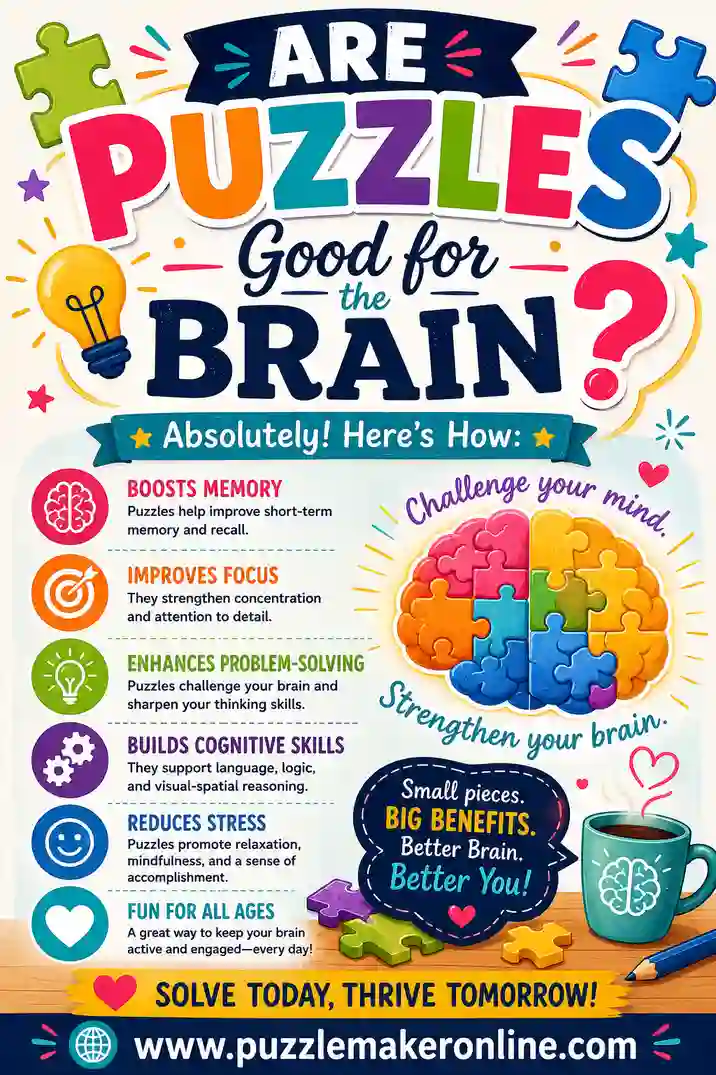
If you're curious about the broader question of what puzzles do for thinking skills, our article on whether puzzles are good for the brain looks at what the research does and doesn't show.
A quick checklist before you print
Run through these questions before you hand a puzzle to a dyslexic solver. If you can answer yes to most of them, you're in good shape.
- Did the solver choose this puzzle, or at least have a say?
- Is the reading load as low as it can be for this type of puzzle?
- Is the type large enough to read comfortably at arm's length?
- Is there extra space between letters, and between lines of instructions or clues?
- Are instructions short, left-aligned and in sentence case, with bold (not underline or italics) for anything important?
- Is there only one puzzle on the page, with no cluttered borders?
- For a word search: is the grid small, uppercase, and limited to across and down?
- For a crossword: is there a word bank, or can the solver check spellings?
- Is there an answer key, so the solver can check work without asking?
- Is there no timer and no competition, unless the solver wants one?
None of these changes make a puzzle "easier" in a way that takes away the challenge. A maze is still a maze, and a logic puzzle still needs logic. They just move the difficulty to where it belongs: in the thinking, not in the decoding.
Many of these tweaks help everyone, too. Clear type, good spacing and uncluttered pages are easier on tired eyes, younger solvers and older solvers alike. Designing for dyslexic solvers usually means designing a better puzzle page for the whole group.
When to talk to a professional
This article is general information. It can't tell you whether someone has dyslexia, and it isn't a substitute for professional advice. If you're worried about a child's or your own reading, spelling or writing, talk to a qualified professional, such as an educational psychologist, a specialist dyslexia teacher or assessor, a pediatrician, or the school's learning support team. If there are concerns about eyesight or visual discomfort, see an eye-care professional too. Rules on assessments, diagnoses and school or workplace accommodations differ between countries, states and school districts, so check what applies where you live.
Make adapted puzzles yourself
The easiest way to get puzzles that fit a particular person is to make them yourself, using words they know and care about, in a size and layout that suits them.
Our free puzzle maker lets you type your own words or pick a theme, choose a puzzle type, and print it with an answer key. Start with a short list of familiar words, and use the tips above, a small grid, clear spacing and simple directions, to keep it friendly. For more on getting clean, readable printouts, see our guide on how to print puzzles.
Six Crossword Adjustments Compared
The trick with crosswords is to separate knowing the answer from spelling the answer. This table compares six simple changes and what each one does.
| Adjustment | What to do | What it helps with |
|---|---|---|
| Word bank | Print all the answers in a box beside the grid | The solver can copy the spelling instead of producing it from memory |
| Bigger squares | Use large-print grids | There is more room to write |
| Short, plain clues | Keep clues brief and simple | Long, wordy clues add reading load before the puzzle even starts |
| Reading clues aloud | Have a child, or anyone who prefers it, hear the clues | It turns the crossword into a listening and thinking game |
| Spelling help | Let solvers use a dictionary, a spell-checker or a partner | The puzzle stays about the ideas |
| Favorite themes | Pick a subject like a favorite sport or animal | It is far more motivating than a random puzzle |
Frequently Asked Questions
Are word searches good for kids with dyslexia?
They can be, but the standard format often isn't. A typical word search packs many small letters closely together and hides words in eight directions, which loads up exactly the skills many dyslexic readers find hardest. Research on letter spacing suggests crowded letters are a particular problem. Adapted word searches work much better: a small grid, large uppercase letters with extra space between them, words only left to right and top to bottom, and a short list of familiar words. Let the child decide whether they enjoy them, and offer mazes or logic puzzles as alternatives.
What puzzles are best for people with dyslexia?
Puzzles with little or no reading are often the most enjoyable: mazes, sudoku, nonograms, KenKen, tangrams, jigsaws and spot-the-difference pictures. They lean on reasoning and visual-spatial thinking, areas where organizations such as the British Dyslexia Association and the Yale Center for Dyslexia & Creativity note many dyslexic people are strong. Word puzzles can still be fun when adapted, for example a crossword with a word bank or a large-print word search. Every person is different, so offering a choice is better than assuming.
Can puzzles help treat dyslexia?
No good evidence shows that puzzles treat or cure dyslexia. Dyslexia is a difference in how the brain processes written language, and reading support comes from qualified teaching and specialist help. Puzzles can still be valuable as an enjoyable hobby, a confidence builder and a low-pressure way to practice skills like attention and planning. If you're concerned about a child's reading or your own, talk to a qualified professional such as an educational psychologist, a specialist dyslexia teacher, or the school's learning support team.
What font is best for dyslexia?
A clear, familiar font with good size and generous spacing is the safest choice. Specialty fonts marketed for dyslexia don't have strong evidence behind them. A 2017 study in the Annals of Dyslexia found that elementary students with dyslexia read no faster or more accurately in OpenDyslexic than in Arial or Times New Roman, though the study was small. Spacing seems to matter more: a 2012 study found that extra-wide letter spacing reduced reading errors in dyslexic children. If someone prefers a particular font, it's fine to use it.
Do colored overlays help with dyslexia?
The evidence doesn't support colored lenses as a treatment. The American Association for Pediatric Ophthalmology and Strabismus says there's no scientific evidence that vision training or colored spectacle lenses improve academic performance in children with learning disabilities. Some people do find tinted paper or overlays more comfortable, and the British Dyslexia Association mentions visual stress, such as text seeming to blur or move, as something to consider. If a person prefers a color, there's no harm in using it, but see an eye-care professional about any visual discomfort.
How do I make a dyslexia-friendly word search?
Keep the grid small, around 7x7 to 10x10. Print the letters large, with extra space between them, and use uppercase for both the grid and the word list so look-alike letters like b, d, p and q are easier to tell apart. Place words only left to right and top to bottom, with no diagonals or backward words. Use six to ten familiar words, print the list in one left-aligned column, and allow a ruler or card to track rows. Skip timers and always include an answer key.
Is sudoku good for dyslexia?
Sudoku is often a good fit because it uses digits only as symbols and involves no reading or spelling. The challenge is logic and pattern-spotting, which many dyslexic solvers enjoy. Start with small 4x4 or 6x6 grids and move up as confidence grows. One caution: some people have co-occurring difficulties, and a dyslexic person who also finds numbers hard may prefer a picture or color version. As with any puzzle, the best choice is the one the person actually enjoys.
Are crossword puzzles too hard for dyslexic people?
Not necessarily. Many dyslexic people have strong vocabularies and general knowledge, so they understand crossword clues well; the hard part is often spelling the answer. A word bank printed beside the grid solves much of that problem, since the solver can copy the spelling. Large squares, short plain clues, reading clues aloud, and permission to use a dictionary or spell-checker also help. Themed crosswords about the solver's interests are especially motivating. Plenty of dyslexic adults enjoy crosswords on their own terms.
How common is dyslexia?
Estimates vary depending on how dyslexia is defined and measured. The Yale Center for Dyslexia & Creativity says it affects 20 percent of the population and makes up 80 to 90 percent of all learning disabilities. The British Dyslexia Association uses a lower estimate of about 10 percent. Whichever figure you use, dyslexia is common, which means any classroom, club or puzzle group is likely to include dyslexic members. Designing puzzles with clear layouts and good spacing helps them and is easier for everyone else to read too.
Sources
We checked every source below while writing this guide. Last reviewed October 30, 2026, by Joan Ramos.
- Reading Disorders: Condition Information (Eunice Kennedy Shriver National Institute of Child Health and Human Development (NICHD))
- What Is Dyslexia? (Yale Center for Dyslexia & Creativity)
- Dyslexia (British Dyslexia Association)
- What is dyslexia? (British Dyslexia Association)
- Things to consider (British Dyslexia Association)
- Learning Disabilities (American Association for Pediatric Ophthalmology and Strabismus)
- Extra-large letter spacing improves reading in dyslexia (Zorzi et al., PNAS, 2012) (PubMed Central, National Library of Medicine)
- The effect of a specialized dyslexia font, OpenDyslexic, on reading rate and accuracy (Wery and Diliberto, Annals of Dyslexia, 2017) (PubMed Central, National Library of Medicine)
- Understanding Success Criterion 1.4.12: Text Spacing (W3C Web Accessibility Initiative)
- Dos and don'ts on designing for accessibility (GOV.UK Accessibility in government blog (Home Office Digital))