Sudoku Difficult Printable: Tough Grids + How to Crack Them
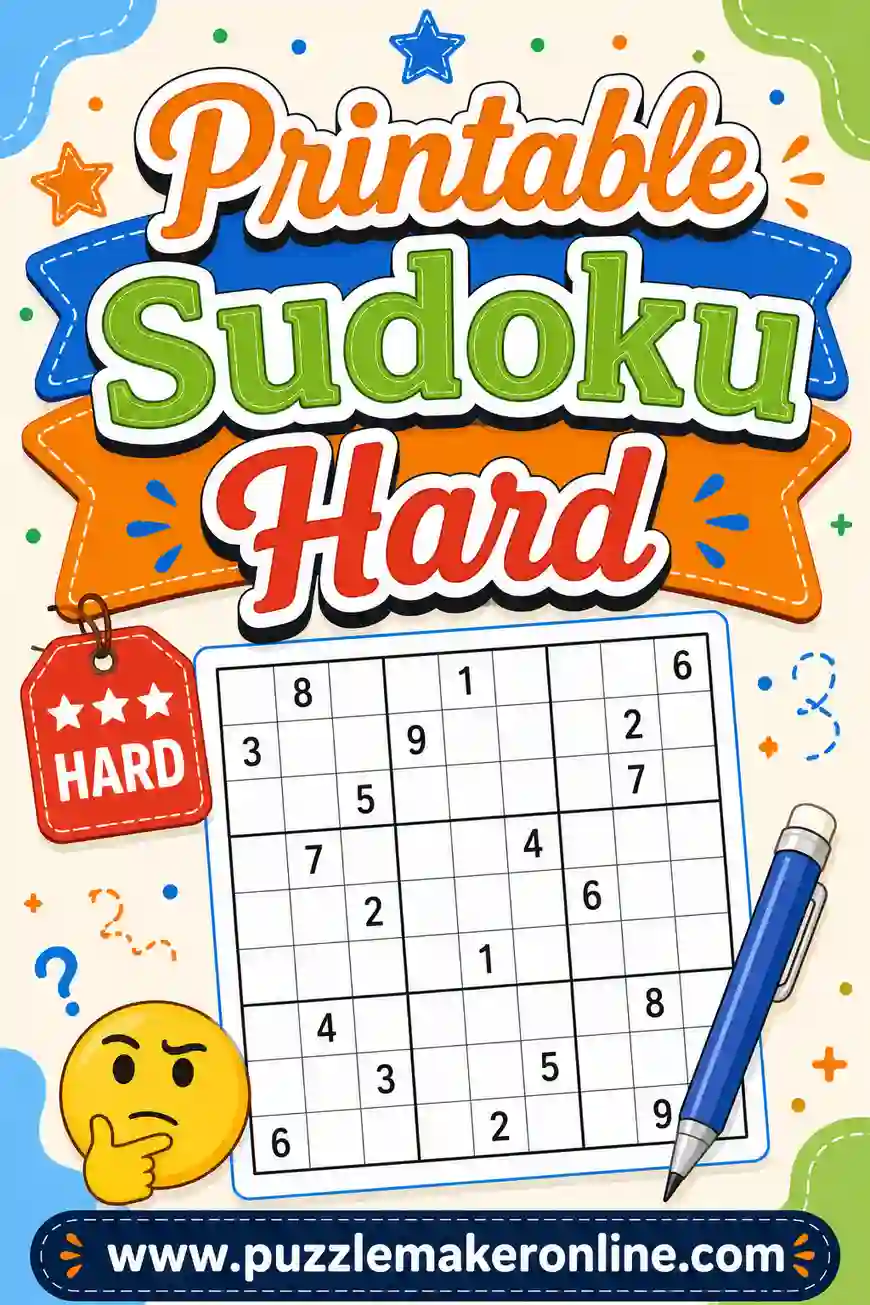
A sudoku difficult printable is a tough 9×9 puzzle on paper — the kind with sparse clues that shrugs off basic scanning and demands real technique. If Medium grids have started falling in fifteen minutes and you want puzzles that push back, this is your level. The free puzzle maker generates them on demand: open the Sudoku tab, choose the Hard setting, and print. Every difficult sudoku printable comes with a guaranteed single solution and a matching answer key, so even the meanest grid is beatable by pure logic — no guessing, ever.
But printing a difficult puzzle is the easy part. This guide is mostly about surviving one: the technique ladder that cracks tough grids, a step-by-step protocol for when you stall, and how to tell whether you're actually improving.
What Actually Makes a Sudoku Difficult
It's not "more numbers to figure out" — every sudoku has 81 cells. Difficulty is about which logic the puzzle forces you to use:
- Fewer and meaner givens. Difficult grids start with fewer clues, placed so the easy deductions run out early.
- No free ride. On an easy grid, simple scanning (where can the 7 go in this box?) carries you to the end. A difficult grid lets scanning fill maybe a third of the cells, then stops paying.
- Required intermediate techniques. To break the stall you need candidate work: pairs, box-line interactions, sometimes a fish pattern. The puzzle is engineered so at least a few cells cannot be found any other way.
The good news is structural: because the generator removes clues only while exactly one solution remains, a difficult puzzle is never unfair. Every stall you hit has a logical key somewhere on the grid. Difficult sudoku is the art of knowing where to look.
How to Print Difficult Sudoku Free
- Open the sudoku generator and click the Sudoku tab.
- Choose Hard — the difficult end of the three presets.
- Pick 1 per page. Trust us on this one: difficult grids demand pencil marks, and pencil marks demand big cells.
- Generate, then Print / Save PDF. The puzzle prints on one page, the full solution on the next.
Print three or four in one batch. A difficult grid can take 40–60+ minutes, and sometimes the correct move is to set a stubborn one aside and start fresh — a luxury you only have if the next puzzle is already on the desk. For the companion guide to this level, see our hard sudoku printable page.
The Technique Ladder: From Scanning to X-Wing
Difficult puzzles are cracked one rung at a time. Here's the ladder, bottom to top, in plain language.
Rung 1: Singles (your bread and butter)
A naked single is a cell with only one possible digit left. A hidden single is a digit with only one possible cell left in a row, column, or box. Every difficult puzzle still opens with a handful of these — find them first and bank the easy progress.
Rung 2: Full candidate marks
When singles dry up, stop and pencil the candidates into every empty cell — small digits in the corners. This feels slow. It is also the single act that separates people who finish difficult puzzles from people who don't. Every technique above this rung reads those marks.
Rung 3: Naked and hidden pairs
Two cells in the same unit that share exactly the same two candidates (say, 3 and 8) lock those digits between them — erase 3 and 8 from every other cell in that unit. The hidden version: if 3 and 8 only appear in two cells of a unit, those cells are the pair, whatever else is scribbled in them. Pair-hunting alone finishes most Hard grids.
Rung 4: Pointing pairs and box-line logic
If, inside one box, a digit's candidates all sit in a single row, that digit must be in that row inside that box — so erase it from the rest of the row outside the box. This is the technique that most often breaks a mid-grid stall.
Rung 5: X-Wing (the gateway to fancy)
Find one digit whose candidates in two different rows are limited to the same two columns. Those four cells form a rectangle; the digit must occupy diagonal corners, so it can be erased from those two columns everywhere else. Spotting your first X-Wing on paper is a genuine rite of passage.
You don't memorize these in an evening. You meet them, one stuck grid at a time.
The Stuck-Grid Protocol
Every difficult solver stalls. Strong solvers stall systematically:
- Re-scan for singles. New placements create new singles constantly; the one you need may have appeared three moves ago.
- Audit your pencil marks. Half of all "impossible" grids are actually a missed erasure — a candidate you forgot to remove after a placement nearby.
- Walk the ladder in order. Pairs, then box-line, then X-Wing. Don't hunt exotic patterns before checking cheap ones.
- Pick your most constrained digit. Whichever number has the most placements already is the one whose remaining candidates are tightest — chase it.
- Stand up. Truly. Ten minutes away resets your eyes, and returning solvers routinely spot a naked single sitting in plain view.
- Check exactly one cell against the key. Last resort: confirm a single cell you suspected, then put the answer page away. One confirmed digit usually restarts the whole logic chain without spoiling the solve.
What's not in the protocol: guessing. If you're guessing, the puzzle has stopped being sudoku.
Know Whether You're Ready for Difficult
An honest self-check, because starting too high is the fastest way to hate this level:
| You can… | Then you're ready for… |
|---|---|
| Finish Easy grids without notes | Medium |
| Finish Medium with occasional pencil marks | Your first Hard grids |
| Finish Hard in under an hour using pairs | Difficult as your daily level |
| Find box-line eliminations without hunting | Timed Hard solves, Samurai sudoku |
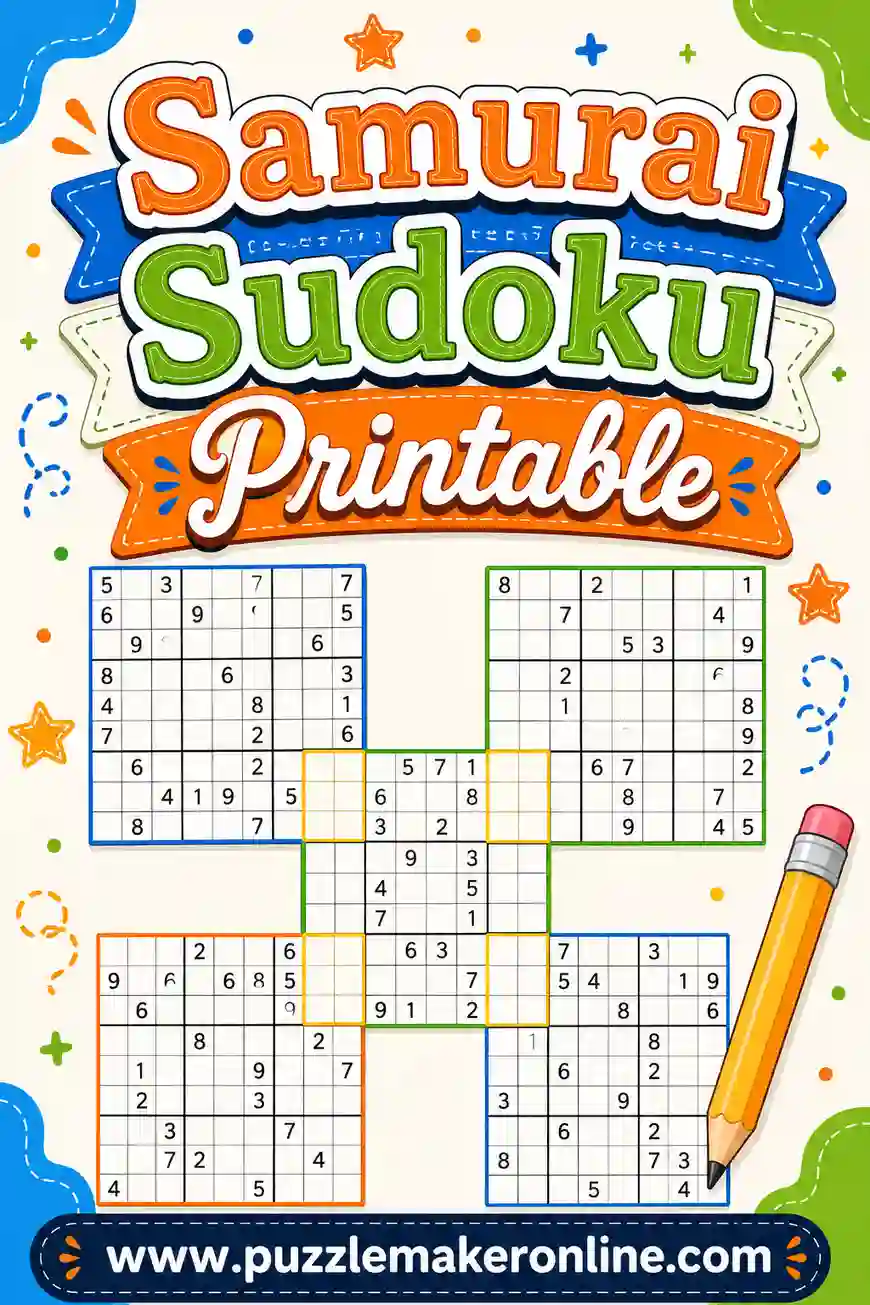
If Medium still requires effort, spend another week there — difficult puzzles assume candidate discipline that Medium builds. And if difficult grids have started feeling routine, the five-grid samurai sudoku format is the natural next mountain.
Why Paper Beats Apps at This Level
The harder the puzzle, the stronger the case for print:
- Pencil marks are the whole game, and paper handles them better than any app — corner notes, cross-outs, circled pairs, your own private notation.
- No accidental hints. Apps love to highlight conflicts and auto-erase candidates, which quietly does Rung 2 for you. On paper, the discipline is real and so is the skill you build.
- Erasing is thinking. Physically removing a candidate after a placement cements the logic in a way tapping doesn't.
- An hour of focus deserves no notifications. A difficult grid is a deep-work session; leave the phone in the other room.
Track Your Progress Like a Solver
Difficult sudoku improves measurably if you keep two habits: date every printed page, and note your solve time and one word about the sticking point ("pairs," "missed single," "X-Wing!"). Over a month you'll see the pattern every improving solver sees — first the DNFs disappear, then the hour becomes forty minutes, then the techniques stop having names and become things your eyes just do.
A nice weekly rhythm: five difficult grids Monday through Friday, then one deliberately relaxed medium puzzle on Saturday to feel how far you've come.
Printing Tips for Battle-Ready Grids
- 1 per page, always. Candidate marks need room. The compact layouts are lovely for easier levels; difficult is not the place.
- Standard quality grayscale. Crisp cell borders matter when a cell holds four tiny pencil digits.
- Sharp pencil, good eraser. A 0.5mm mechanical pencil and a separate block eraser are the tools of the trade.
- Print the solution page — then exile it. Same room, different surface, face down. Close enough for the one-cell rescue, far enough to require intent.
- Batch your week. Print five at once; a stuck grid should never end the session.
Common Mistakes at the Difficult Level
- Skipping full candidate marks to "save time." It costs the puzzle. Marks are the price of admission at this level.
- Forgetting to erase. Stale candidates cause more wrong turns than hard logic does. Erase in the cells you affect after every placement.
- Guess-and-check. It occasionally works, teaches nothing, and turns a logic puzzle into a coin flip you can't unwind on paper.
- Hunting X-Wings while singles sit unfound. Cheap deductions first — always re-scan after any elimination.
- Quitting a grid that's actually fine. A wall usually means one missed elimination, not an impossible puzzle. The unique-solution guarantee means the way through exists. Walk the protocol.
Frequently Asked Questions
Are these difficult sudoku printables free?
Yes — generate and print unlimited puzzles at the Hard setting with the free puzzle maker. No account, no watermark, no daily cap.
Is "difficult" the same as the Hard setting?
Yes. The generator's three presets are Easy, Medium, and Hard — Hard is the difficult end, built to require candidate work and intermediate techniques rather than plain scanning.
Can every difficult puzzle really be solved without guessing?
Yes. Each puzzle is generated from a complete valid grid with clues removed only while exactly one solution remains, so a pure-logic path always exists — even when it's hiding behind an X-Wing.
How long should a difficult sudoku take?
Anywhere from 30 to 90 minutes depending on experience. Under an hour with pencil marks and pair logic is solid; under 30 minutes consistently means you're ready for timed solves or samurai grids.
What's the single best technique to learn next?
Full candidate marking, if you don't do it yet — it unlocks everything else. If you do, learn naked pairs; they resolve more difficult-grid stalls than any other single pattern.
What if difficult puzzles are too hard right now?
Step back to medium sudoku for a couple of weeks and practice pencil-mark discipline there. The jump back up lands completely differently once pairs start jumping out on their own.
Ready to Meet a Grid That Fights Back?
Open the free sudoku generator, set it to Hard, print a battle-ready 1-per-page grid, and bring the technique ladder with you. Stall, breathe, walk the protocol, and enjoy the particular silence of the last twenty cells falling in a cascade. When this level starts feeling like home, the hard sudoku guide has more at your weight class — and samurai sudoku is waiting above it. Sharpen the pencil. Bring the eraser.