Sudoku for Beginners: Printable Puzzles + First-Solve Guide
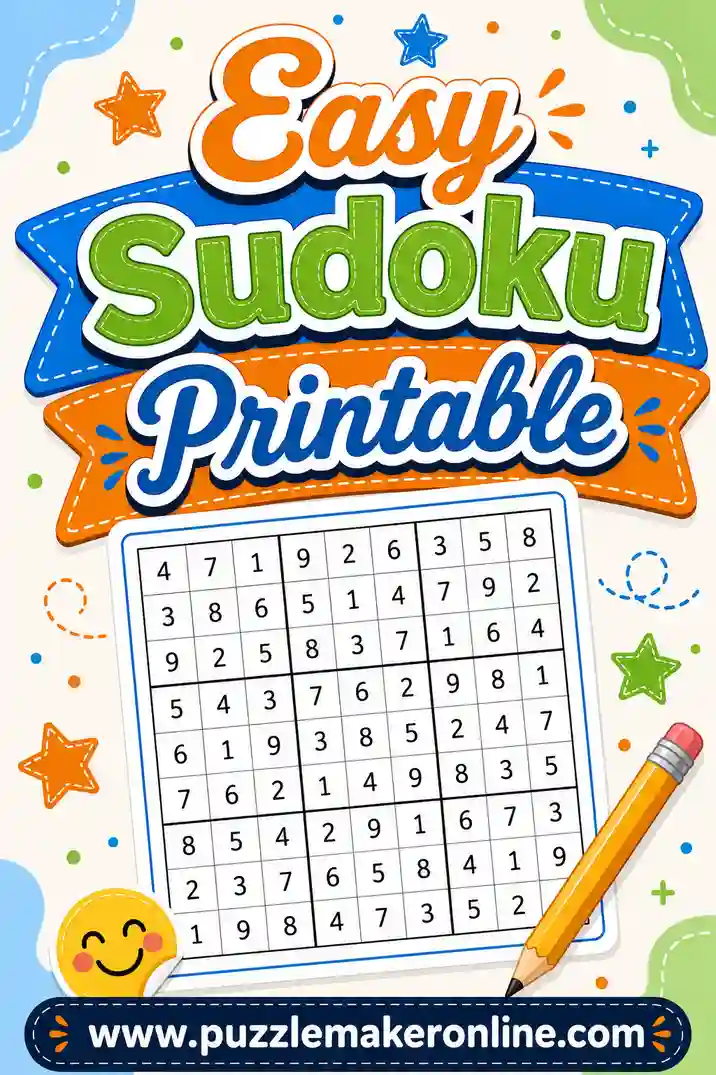
Sudoku for beginners printable puzzles are the single best way to learn this game — a paper grid, a pencil, and no app timer judging you. If you've never solved a sudoku (or you've started three and finished none), this guide takes you from "what are the rules again?" to confidently finishing your first grid. The free puzzle maker supplies the puzzles: pick Easy on the Sudoku tab, print one big puzzle per page, and every grid is guaranteed to have exactly one solution you can reach by logic alone — no guessing ever required.
Here's the whole path: rules in sixty seconds, the two moves that solve beginner puzzles, a walkthrough of your first solve, and a four-week plan to Medium.
The Rules in Sixty Seconds
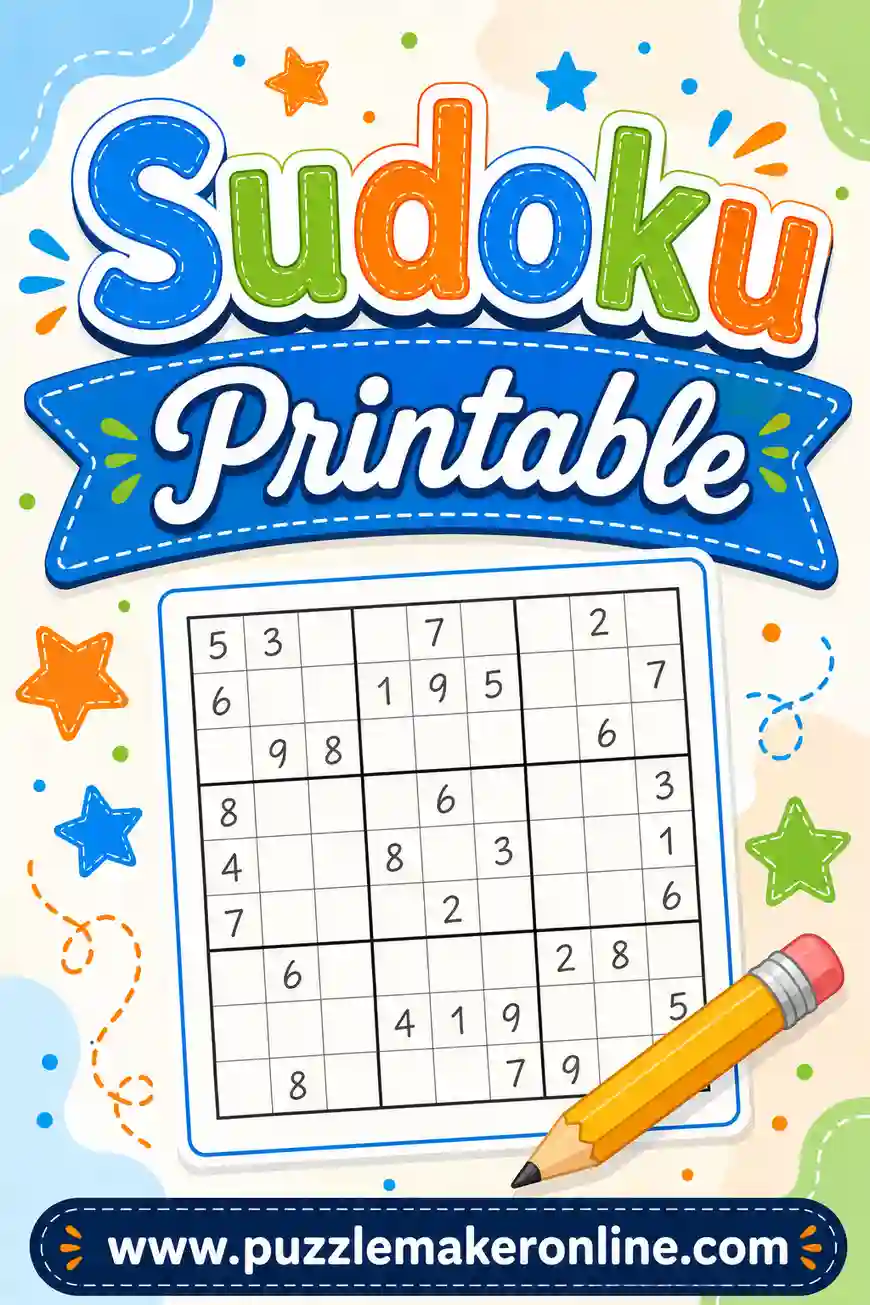
A sudoku is a 9×9 grid, divided into nine 3×3 boxes. Some cells already contain numbers — those are the "givens." Your job is to fill every empty cell with a digit from 1 to 9 so that:
- Every row contains 1 through 9 with no repeats.
- Every column contains 1 through 9 with no repeats.
- Every 3×3 box contains 1 through 9 with no repeats.
That's the entire rulebook. Two beginner-calming facts follow from it. First, there is no math — you never add or subtract anything; the digits could just as well be nine animals. Second, on a properly made puzzle there is always exactly one solution, and every step toward it can be found by logic. If you're guessing, you've missed something findable — which is a comfort, not a criticism.
Why Beginners Should Learn on Paper
Apps flash red the instant you err, autofill your pencil marks, and generally do the thinking you're trying to learn. A printable beginner sudoku teaches better because:
- Pencil marks are the skill. Writing tiny candidates in cell corners — and erasing them as you learn more — literally is sudoku technique. Paper makes it natural.
- No error buzzer means real deduction. When nothing corrects you instantly, you learn to verify placements yourself, which is the habit that makes you good.
- No timer, no streak, no pressure. A paper puzzle waits patiently through dinner.
- Big cells, big comfort. Printed one per page, cells are roomy enough for notes — far better than fingertip-typing on a phone grid.
Print Your First Puzzle in 4 Steps
- Open the Sudoku tab on the free puzzle maker.
- Choose Easy. Easy grids have more givens and yield to the two basic moves below — exactly what you want for the first couple of weeks.
- Choose 1 per page. Maximum cell size, maximum pencil room. (Later, 2, 4, or 6 per page make great practice packs.)
- Generate and print. The puzzle prints on one page and the full solution on the next. Print several — beginner sudoku printable pages get consumed fast once the game clicks.
No sign-up, no watermark, no daily limit. Title the page "My First Sudoku" if you want the fridge-door keepsake version.
The Two Moves That Solve Every Easy Puzzle
Forget the technique encyclopedias for now. Beginner grids fall to exactly two habits.
Move 1: Scan a number
Pick the digit that appears most among the givens — say there are six 5s on the grid. For each 3×3 box that's missing a 5, look at which of its empty cells could legally hold one: any cell sharing a row or column with an existing 5 is out. When only one legal cell remains in that box, write the 5 in. Pure elimination, no guessing. Then scan the next digit.
Move 2: Fill the crowded house
Find any row, column, or box that's nearly full — six or more cells filled. The empty cells have very few possibilities; check each against its row, column, and box. Often only one digit fits, and every cell you fill makes the neighborhood more crowded, which unlocks the next cell. Solvers call these "naked singles"; you'll call them momentum.
When you stall: switch moves. Scanning stopped producing? Hunt crowded rows. Crowded rows dried up? Re-scan digits — your new placements have changed the board. Alternating these two moves cracks every Easy puzzle the generator makes.
Your First Solve, Walked Through
Here's what a successful first session actually looks like, so you know you're doing it right:
- Count the givens for each digit (a quick tally in the margin). Start scanning with the most common digit — it has the fewest hiding places.
- Make your first placements from scans. Expect three to six easy wins in the first few minutes. Confidence installed.
- Hit the first wall — normal. Scanning stalls for everyone. Switch to crowded rows and boxes.
- Start pencil marks, small and few. In two or three stubborn cells only, write the possible digits in tiny print in a corner. Don't mark the whole grid — beginners who do drown in their own notes.
- Watch a pencil mark die. You place a 7 somewhere, and one of your noted cells loses its 7 candidate, leaving just one digit. Fill it. This chain reaction — placements killing candidates, candidates becoming placements — is the entire feeling of sudoku.
- The endgame cascade. The last dozen cells usually fall in one happy rush. Enjoy it; it never stops being satisfying.
Expect 20–40 minutes for a first Easy grid. Speed is not the goal — the goal is finishing with every placement reasoned, not guessed.
The Golden Rule: Never Guess
One rule separates people who learn sudoku from people who quit: if you're not certain, don't write it big. A guessed digit that's wrong poisons every deduction built on it, and you won't find the wreckage until the grid contradicts itself twenty minutes later. When you're unsure, that cell gets pencil marks, not a commitment. On a properly built puzzle — and every grid from this sudoku generator is verified to have a unique, logic-reachable solution — there is always a findable next move. Stuck really means "haven't looked at it the right way yet," and the fix is switching moves or taking five minutes away, not gambling.
Your Four-Week Beginner Plan
A little structure turns "I tried sudoku once" into an actual skill:
| Week | Goal | |
|---|---|---|
| 1 | Easy, 1 per page, one daily | Finish using only the two moves — no time pressure |
| 2 | Easy, 2 per page | Finish without checking the key until the end |
| 3 | Easy, 4 per page | Comfortable pencil-mark habit; under 15 minutes a grid |
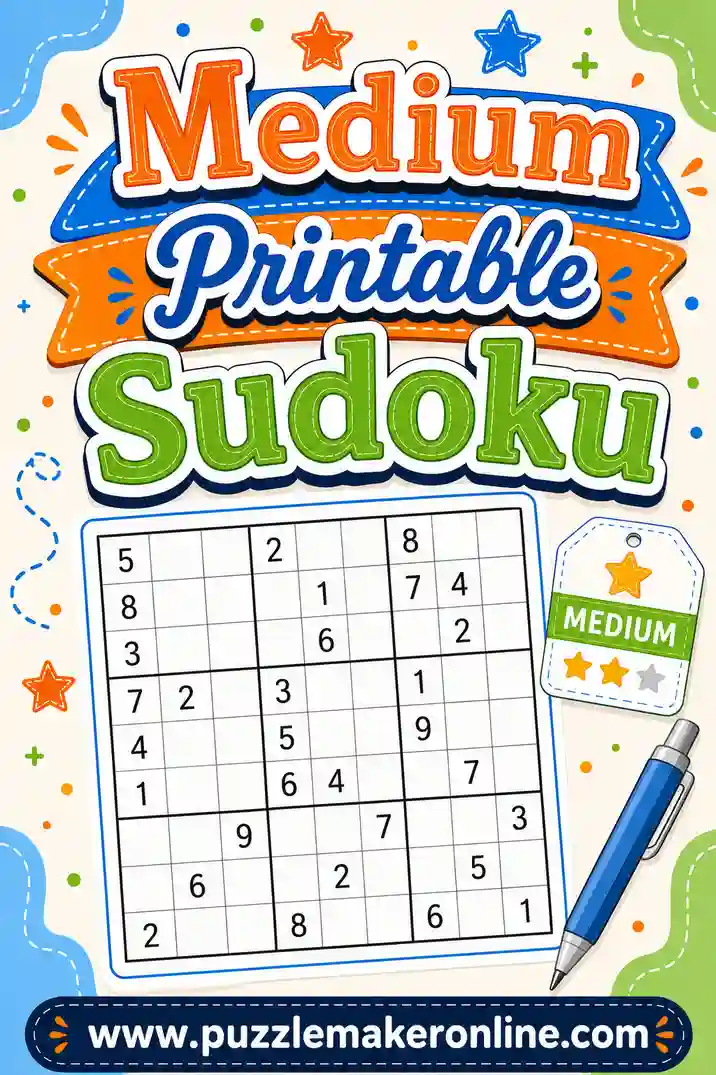
| 4 | Mix: 3 Easy + 1 Medium | Survive your first Medium — expect it to take a while |
The move-up signal is boredom: when Easy grids finish on autopilot and pencil marks feel optional, you're ready. Our easy sudoku guide has more on squeezing value from the Easy level, and the medium sudoku guide covers the candidate techniques that level demands.
Beginner Mistakes (Everyone Makes Them)
- Solving in pen. You will erase. Everyone erases. A sharp pencil with a good eraser is beginner equipment #1.
- Guessing when stuck. See the golden rule. Guessing doesn't just risk the grid; it skips the exact thinking you're trying to build.
- Pencil-marking all 81 cells. Marks are for stubborn cells only. A fully annotated grid is noise, not progress.
- Forgetting the box rule. Beginners check row and column, then plant a digit that already sits in the 3×3 box. Before writing, glance at all three neighborhoods.
- Starting on Medium or Hard. A too-hard puzzle teaches nothing except that sudoku is "not for you." It is — at the right level. Difficulty guidance for every level is in our sudoku printable overview.
- Treating the answer key as failure. Checking one cell to un-stick yourself is smart practice. Confirm a single digit, learn where your logic slipped, keep going.
Teaching a Kid (or a Grandparent) From Your Printout
Beginner sudoku is also the best shared puzzle, because the two moves are teachable in one sitting. Print two copies of the same Easy grid (print before regenerating so they match), sit side by side, and take turns finding placements out loud — "there's only one place the 4 can go in this box, see why?" Saying the logic aloud cements it for both of you. Kids from about age eight can handle a real 9×9 Easy grid this way, and it's a lovely low-pressure activity with an older parent: no rules to remember beyond row-column-box, no speed, and a visible finish line you reach together.
Printing Tips for Learners
- 1 per page while learning. Room for pencil marks is room for thinking.
- Print the solution page — and fold it. Available but not staring at you.
- Black and white draft mode is fine. Sudoku needs no color; save the ink for photos.
- Print a small stack. Momentum matters: finishing your first grid and immediately starting another is how the hobby actually takes hold.
- Keep finished grids for a week. Seeing your solve count grow is embarrassingly motivating.
Frequently Asked Questions
What's the best printable sudoku for a complete beginner?
An Easy puzzle printed 1 per page from the free sudoku generator — more givens, big cells for pencil marks, and a solution page for checking. Print several so a finished puzzle rolls straight into the next.
Are these beginner sudoku printables free?
Yes — free, no sign-up, no watermark, unlimited puzzles. Print one a day for a year if you like; it costs only paper.
Does sudoku involve math?
None. You never calculate anything — the digits 1–9 are just nine distinct symbols. Sudoku is pure logic and pattern-spotting, which is why it suits everyone from kids to grandparents.
How long should a beginner puzzle take?
First grids commonly take 20–40 minutes; after a couple of weeks of daily Easy puzzles, 10–15 minutes is typical. Speed arrives on its own — accuracy first.
Do I ever need to guess?
Never. Every puzzle from the generator is verified to have exactly one solution reachable by logic alone. If you're stuck, switch techniques or step away — a findable move always exists.
When should I move up from beginner puzzles?
When Easy grids feel automatic and you barely need pencil marks — usually a few weeks of regular solving. Step up to medium sudoku and expect a healthy struggle at first; that's the level doing its job.
Ready for Your First Grid?
Open the free sudoku maker, pick Easy and 1 per page, print, and grab a pencil — the two moves above will carry you through the whole grid, and the answer key is right there if you wobble. A month from now you'll be the person who "does sudoku," casually terrorizing medium puzzles with tiny pencil marks. Every solver started with one Easy grid. Print yours.