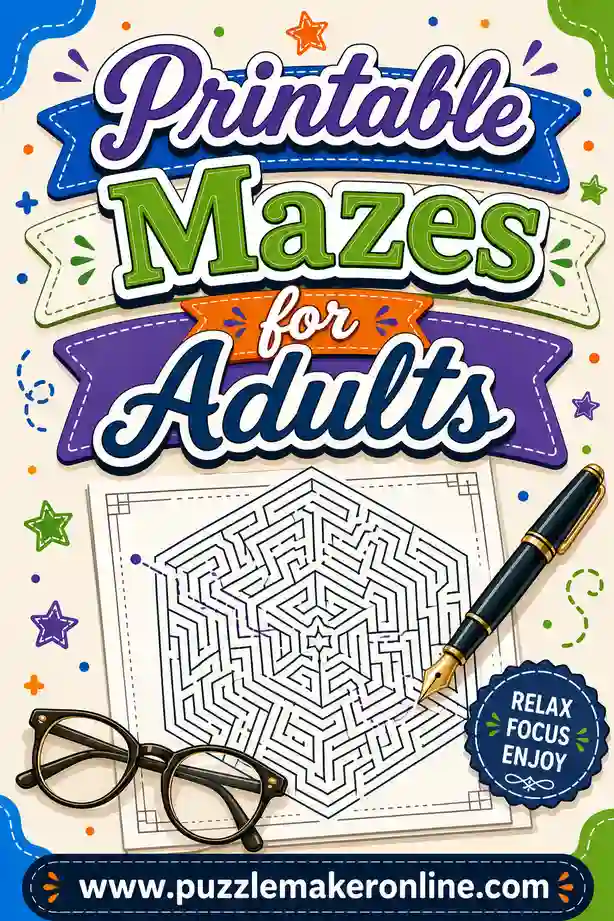
Printable Mazes for Adults: Free Hard Mazes to Print
Printable mazes for adults are exactly what they sound like: proper, dense, genuinely challenging mazes on paper — not the six-turn puzzles from a kids' menu. Adults are quietly one of the biggest maze audiences around, because a good maze is a rare thing: a five-to-twenty-minute task that demands total focus, requires zero vocabulary or math, and ends with a clean, satisfying win. The free puzzle maker generates a fresh maze on demand — pick Hard for the biggest, twistiest grid — with a single winding path from Start to Finish and an answer key showing the solution route.
This guide covers how to print adult-level mazes free, real solving strategies beyond wandering, and why a paper maze makes a shockingly good screen break.
Wait — Mazes for Grown-Ups?
Yes, and unapologetically. Somewhere along the line mazes got filed under "kids' activity," while adults kept buying them anyway in the form of puzzle apps, escape rooms, and those elaborate maze books that sell steadily to people who would never admit it at dinner parties.
The appeal makes sense once you name it. A maze is a pure spatial-reasoning task: no trivia you might not know, no vocabulary gatekeeping, no arithmetic. It engages planning, working memory, and visual tracking all at once, and it produces something psychologists would call a "closed loop" — a task with a clear start, a clear end, and a visible moment of completion. That's precisely the kind of activity that feels restful to a brain that spends all day on open-ended, never-finished work.
An adult-level maze just needs enough size and branching to put up a real fight — which is a settings question, not a category question.
How to Print Adult-Level Mazes in 4 Steps
- Open the maze generator and click the Maze tab.
- Pick Hard. The difficulty buttons set the maze size — Hard produces the largest grid with the longest, most deceptive corridors.
- Title it if you like — "Tuesday's Escape Attempt" prints across the top of the page.
- Generate and Print / Save PDF. The empty maze prints on one page; the answer key prints the same maze with the solution path drawn through it.
Every maze is a "perfect maze," meaning there's exactly one path from the Start in the top-left corner to the Finish in the bottom-right — no loops, no shortcuts, no unreachable rooms. Don't like the layout? Hit Generate again and a completely new maze appears. There's no daily limit, so print a stack.
What Actually Makes a Maze Hard
Worth knowing, because "big" is only part of it:
- Size. More cells means more corridor to search and a longer solution path. This is the main lever the Easy/Medium/Hard buttons pull.
- Branching depth. Hard mazes hide long, confident-looking dead ends that waste thirty seconds each. The cruelest branches run toward the finish before dying.
- Solution-path shape. An easy maze's path trends diagonally from corner to corner. A hard maze's path doubles back on itself, sometimes traveling away from the finish for long stretches.
A genuinely difficult maze exploits your intuition — you assume progress means moving down and right, and the maze quietly punishes the assumption. If you want to explore the difficulty spectrum properly, our hard mazes and difficult maze guides break down the tougher end in detail.
Real Solving Strategies (Beyond Wandering)
Most adults solve mazes the way they left off at age nine: pick a direction, hope. These four techniques are what maze enthusiasts actually use.
1. Scan before you draw
Spend the first thirty seconds tracing with your eyes only. You're building a rough mental map of which regions connect — and you'll often spot the choke points the whole solution must pass through.
2. Solve backward from the Finish
Paths near the finish usually branch less, because the maze designer's tricks are concentrated near the start and middle. Trace backward until the route gets ambiguous, mark where you got to, then solve forward to meet it.
3. Fill the dead ends
The methodical approach: lightly shade any corridor that ends in a wall, working inward. Every shaded dead end simplifies the picture, and what remains unshaded at the end is the solution. Slow, but unbeatable — and weirdly meditative.
4. Wall-following, used honestly
Keep one hand on the right-hand wall (mentally) and follow it everywhere it goes. In a perfect maze, it will eventually reach the finish. It's a guaranteed method, though rarely the fastest — think of it as a rescue technique for when you're hopelessly turned around.
Pencil discipline helps every method: trace lightly so wrong turns erase cleanly, and mark junction points with a small dot when you've exhausted one branch.
The Maze as a Screen Break
Here's the modern use case that surprises people. A printed maze is an almost perfect micro-break for desk workers: it takes five to fifteen minutes, occupies visual attention completely (which is what pushes work rumination out), involves no screen, and can't send you notifications. Compare that to "taking a break" on your phone, which reliably turns five minutes into twenty-five.
A simple pattern that sticks: print five hard mazes on Monday, keep them in a desk drawer, and trade one afternoon scroll session per day for one maze. Solvers who try it tend to report the same two things — the afternoon slump passes faster, and finishing something, even a maze, resets momentum for actual work.
More Ways Adults Use Printable Mazes
- Waiting rooms and flights. A folded maze in a bag beats staring at a gate screen. No battery, no seat-back Wi-Fi fee.
- Race night. Print the same maze twice (print two copies before regenerating!) and race a partner or friend head-to-head. Loser makes the coffee.
- Senior brain workouts. Mazes exercise visual-spatial skills that word puzzles don't touch, and the paper format suits solvers who find apps fiddly. Medium difficulty is usually the sweet spot for comfortable challenge.
- Recovery and low-energy days. When reading feels like too much, a maze asks nothing verbal of you at all.
- Party icebreakers. A timed maze race is a surprisingly leveling competition — spatial talent hides in unexpected people.
Build a Weekly Maze Ladder
One maze is a diversion; a graded stack is a hobby. Try this progression:
| Day | Difficulty | Goal |
|---|---|---|
| Mon | Medium | Solve clean, no backtracks drawn |
| Tue | Medium | Beat Monday's time |
| Wed | Hard | Just finish |
| Thu | Hard | Finish with eyes-first scanning |
| Fri | Hard | Race the clock — set a target time |
Write your time on each finished maze. Spatial skills improve with repetition just like sudoku scanning does, and within a couple of weeks the Hard grids that once took fifteen minutes start falling in six. For the full difficulty tour, start at our general printable mazes guide.
Printing Tips for Clean Corridors
- Black and white is all you need. Maze walls print crisply in grayscale; skip color entirely.
- Standard quality over draft. Thin corridor walls deserve dark lines — draft mode can make dense Hard mazes slightly harder to read.
- One maze per page. Adult mazes use the space; let them have it.
- Print the answer key, but exile it. Same maze, solution path drawn through it — great for checking, fatal for willpower if it's sitting face-up next to you.
- Pencil over pen. Every maze solver backtracks. Erasing keeps the final solved page satisfying instead of scribbled.
Common Mistakes to Avoid
- Printing kid-sized mazes and getting bored. If a maze falls in ninety seconds, it wasn't an adult maze. Go straight to Hard.
- Drawing boldly from the start. Confident ink on a wrong branch means an ugly page and a harder restart. Trace lightly until the route proves itself.
- Ignoring the backward-solve. It feels like cheating; it isn't. It's the single biggest speed upgrade available.
- Solving with the answer key in view. Your eyes will steal the route before your brain gets to work. Separate pages, separate places.
- Stopping at one. The first maze is calibration. The fun starts when you race your own times across a stack.
Frequently Asked Questions
Are these printable mazes for adults free?
Yes — generate and print unlimited mazes with the free puzzle maker, no account or watermark. A week's stack of hard mazes costs you five sheets of paper.
What makes an adult maze different from a kids' maze?
Size and deception. Adult-level mazes (the Hard setting) have far more cells, longer dead-end branches, and solution paths that double back — so they take minutes of real concentration rather than seconds of pen-wiggling.
Do the mazes come with solutions?
Yes. The answer key prints the identical maze with the solution path drawn from Start to Finish, so you can check your route — or rescue a hopeless one — at a glance.
Is solving mazes actually good for your brain?
Mazes exercise visual-spatial reasoning, planning, and working memory — a different muscle group than word puzzles. Like any puzzle habit, the benefit comes from regular, comfortably-challenging practice rather than one heroic session.
Can two people solve the same maze competitively?
Yes — print two copies of the same maze before generating a new one, hand one to each racer, and count down. Same maze, same start, first to the finish wins.
Every maze really has only one path?
Yes. The generator builds perfect mazes: exactly one route connects Start (top-left) to Finish (bottom-right), with no loops or shortcuts. Every dead end you hit is the maze working as intended.
Ready for a Proper Maze?
Open the free maze generator, hit Hard, and print your first real challenge — answer key tucked safely on page two. Try the backward-solve, race your own time tomorrow, and keep a drawer stack for the afternoon slump. When you're ready to explore the whole difficulty range, our printable mazes guide covers it end to end, and the hard mazes guide lives at the deep end. The couch is waiting — you just have to find the path to it.