Free Printable Sudoku 6 Per Page: Big Packs, Less Paper
Free printable sudoku 6 per page means exactly that: six complete 9×9 puzzles arranged on a single sheet, so one piece of paper holds a whole afternoon of solving. It's the layout of choice for road trips, classroom sets, homemade puzzle books, and anyone whose ink budget matters. The free puzzle maker has it built in — open the Sudoku tab, pick your difficulty, choose "6 per page" from the puzzles-per-page menu, and print. The six puzzles land on one page and all six solutions print on the next.
This guide covers when six-per-page is the right call (and when it isn't), the paper math that makes it so efficient, and how to turn a few sheets into a travel pack or a full booklet.
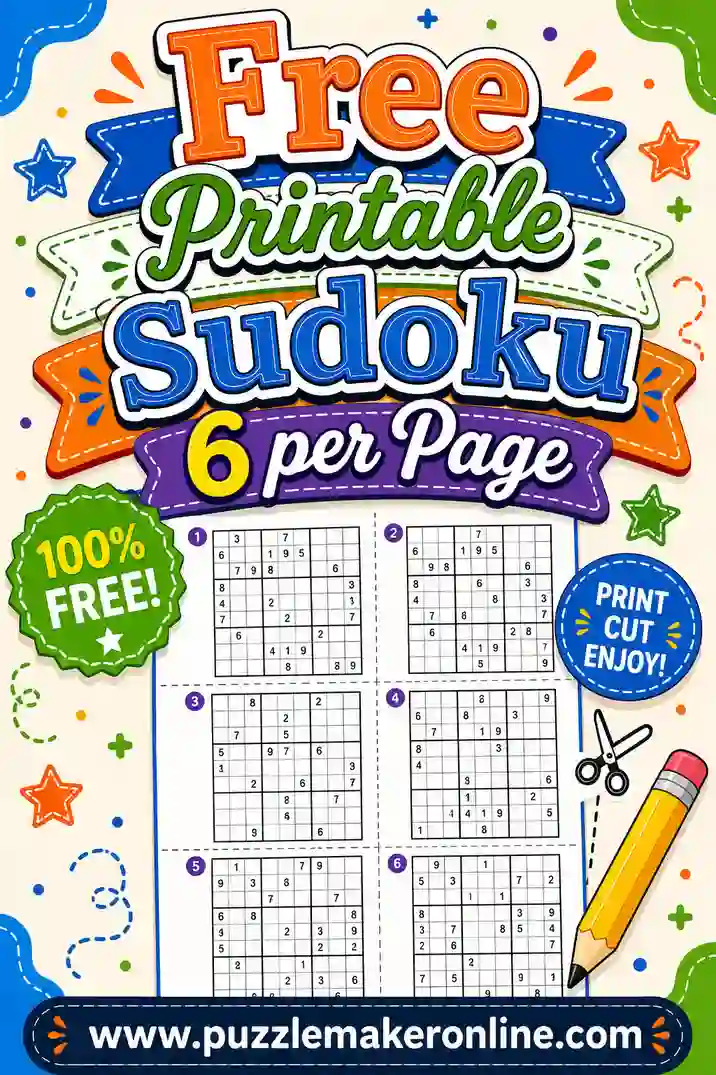
What a 6-Per-Page Sudoku Sheet Looks Like
Picture a standard letter-size page split into a 2×3 arrangement: six 9×9 sudoku grids, each with its own difficulty-appropriate set of givens, plus an optional title across the top of the sheet. Each grid is smaller than a full-page puzzle — cells around the size you'd find in a pocket puzzle book — but every puzzle is complete, independent, and has its own guaranteed-unique solution.
When you hit Print / Save PDF, the layout does the sensible thing: puzzles on one page, all six matching solutions on the following page in the same arrangement, so checking puzzle #4 means glancing at position #4 on the key. No buttons, menus, or clutter make it onto the printed page.
The Paper Math: Why 6 Per Page Wins for Volume
The efficiency case is straightforward and honestly satisfying:
| Pack size | Sheets at 1/page | Sheets at 6/page | Paper saved |
|---|---|---|---|
| 12 puzzles | 12 | 2 | 83% |
| 30 puzzles | 30 | 5 | 83% |
| 60 puzzles | 60 | 10 | 83% |
| 120 puzzles | 120 | 20 | 100 sheets |
Ink savings track the same way, since you're printing six grids' worth of lines per pass of the page. For a classroom teacher printing weekly sets, or anyone assembling a 100-puzzle gift book, the difference between a ream of paper and a couple dozen sheets is the difference between "sure, why not" and "maybe next month."
How to Print Free Sudoku 6 Per Page in 4 Steps
- Open the sudoku generator and click the Sudoku tab.
- Pick a difficulty — Easy, Medium, or Hard. All six puzzles on the sheet match the difficulty you choose.
- Set "Puzzles per page" to 6. The menu offers 1, 2, 4, or 6; pick 6.
- Generate, then Print / Save PDF. Choose "Save as PDF" in the print dialog if you're building a pack to print later.
Want a mixed-difficulty pack? Print one 6-per-page sheet at each level — three sheets gives you 18 puzzles spanning Easy to Hard, which is a genuinely great starter pack for a household with different skill levels.
When 6 Per Page Is the Right Choice (and When It Isn't)
Six-per-page is a volume-and-portability layout, not an everyday-comfort layout. Here's the honest matchup:
| Layout | Cell size | Best for |
|---|---|---|
| 1 per page | Largest | Seniors, beginners, heavy pencil-markers |
| 2 per page | Comfortable | Everyday solving with note room |
| 4 per page | Compact | Experienced solvers, travel |
| 6 per page | Smallest | Speed solvers, packs, books, Easy–Medium grids |
The trade-off is pencil-mark room. Small cells hold a final digit happily but get crowded once you're jotting three candidates in a corner. That leads to a practical rule of thumb: 6 per page shines at Easy and Medium, where most cells get solved by scanning. For Hard puzzles — where candidate notes do the heavy lifting — most solvers are happier at 1 or 2 per page. Our medium sudoku guide covers that sweet-spot difficulty where compact sheets still solve comfortably.
One good workaround if you love compact sheets but need note space: print a blank sudoku grid as a worksheet, copy a stubborn puzzle onto it, and work the hard one at full size.
Build a Travel Pack in Ten Minutes
The 6-per-page layout was practically invented for travel. Here's a proven road-trip formula:
- 2 sheets of Easy (12 puzzles) — warm-ups and wind-downs
- 2 sheets of Medium (12 puzzles) — the main event
- 1 sheet of Hard (6 puzzles) — for the long flight leg or rainy afternoon
- Answer sheets folded at the bottom of the bag — checked only in emergencies
That's 30 puzzles on five sheets, light enough for any carry-on, no battery or Wi-Fi involved. Slip the stack into a gallon zip bag with two pencils and an eraser, and you've built the cheapest in-flight entertainment system in aviation history. Clipboards make solving on a knee or a tray table dramatically nicer.
Make a Homemade Sudoku Booklet
A few 6-per-page sheets fold naturally into a giftable puzzle book:
- Print 10 sheets — say 4 Easy, 4 Medium, 2 Hard — for a 60-puzzle book.
- Title each sheet as you generate: "Warm-Ups," "The Middle Miles," "The Deep End." The title box prints across the top of the page.
- Print all answer pages and group them at the back, just like a store-bought book.
- Add a cardstock cover and staple or ring-bind. Total cost: pennies. Retail equivalent: $10+.
These make lovely, personal gifts for grandparents, hospital stays, care packages, and long train commutes — and if the recipient finishes it, the sequel prints in ten minutes.
Classroom Sets Without the Copier Guilt
Teachers are the biggest fans of the 6-per-page layout for a reason: one sheet per student is an entire week of morning work. A workable classroom pattern:
- Monday–Friday, one grid per morning. Students initial and date each finished puzzle on the sheet.
- Print Easy for the first month, then move the class to Medium as scanning skills settle in.
- Post the answer page on Friday so students self-check the week.
- Keep spare sheets in the early-finisher folder. Sudoku needs no reading level, which makes it one of the fairest quiet activities in a mixed-ability room.
Thirty students × six puzzles = 180 puzzles on 30 sheets, which is one trip to the copier instead of six.
Solving Comfortably on Smaller Grids
Compact cells reward tidy habits. A few adjustments experienced small-grid solvers make:
- Use a sharp pencil, not a chunky one. A 0.5mm mechanical pencil keeps digits legible at small sizes.
- Write candidates as dots, not digits. A corner dot pattern (top-left = 1, top-center = 2…) holds notes in less space than tiny numerals.
- Solve the easiest grid first. The six puzzles are independent, so build momentum in whatever order you like.
- Cross off finished grids. A big pencil check in the corner of each completed puzzle keeps your eye from re-scanning solved territory.
- Escalate stubborn grids to paper you can breathe on. Copy the one nasty puzzle to a blank grid rather than squinting through a candidate storm.
Printing Tips for Crisp Small Grids
- Skip draft mode for 6-per-page. Unlike full-size grids, small cells need dark, crisp lines — standard quality grayscale is the sweet spot.
- Print a test sheet first. Confirm all six grids sit inside your printer's margins before running a stack.
- Choose portrait orientation and let the layout do the work. The 2×3 arrangement is designed for letter-size paper.
- Heavier paper helps. Six puzzles means six visits from the eraser; 24 lb paper survives all of them.
- Save every sheet as a PDF. A named folder ("sudoku-pack-easy-01.pdf"…) becomes a permanent, reprintable library.
Frequently Asked Questions
Is printable sudoku 6 per page really free?
Yes. The puzzle maker generates unlimited 6-per-page sheets free — no account, no watermark, no cap. Print two sheets or two hundred.
Do all six puzzles come with solutions?
Yes. The six solutions print on their own page, arranged in the same 2×3 positions as the puzzles, so matching a grid to its answer takes a glance.
Are all six puzzles the same difficulty?
On any single sheet, yes — the sheet inherits the difficulty you pick. For a mixed pack, print one sheet per level; three sheets covers Easy, Medium, and Hard.
Can I save it as a PDF instead of printing right away?
Yes. Click Print / Save PDF and choose "Save as PDF" in the dialog. That gives you a free printable sudoku 6 per page PDF you can store, share, or reprint whenever the pack runs dry.
Are the grids big enough to actually solve?
For Easy and Medium, comfortably — cells are pocket-puzzle-book size. For Hard puzzles that need heavy candidate notes, most solvers prefer 1 or 2 per page, or copy the tough grid onto a blank worksheet.
Does each small puzzle still have a unique solution?
Yes. Every puzzle, at every layout, is built from a complete valid grid with clues removed only while exactly one solution remains — solvable by logic, never by guessing.
Ready to Print Your Six-Pack?
Open the free sudoku generator, set the per-page menu to 6, pick your difficulty, and print — one sheet, six fresh puzzles, answers on the page behind. Build the travel pack, run the classroom week, or bind the sixty-puzzle booklet. And when you want the full tour of layouts and difficulty levels, the sudoku printable guide has you covered. One sheet of paper rarely works this hard.